
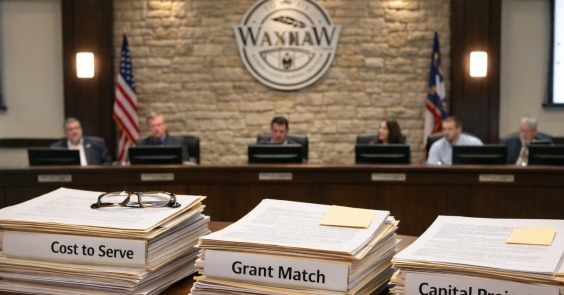
The Waxhaw Board of Commissioners held a lengthy work session on February 24, 2026, covering topics ranging from honoring a World War II veteran to multimillion-dollar infrastructure commitments and long-standing questions about growth and fiscal sustainability.
While no formal votes were taken — as this was a work session — several discussions preview significant financial decisions the Board will soon face.
Honoring Major Charles E. Rose
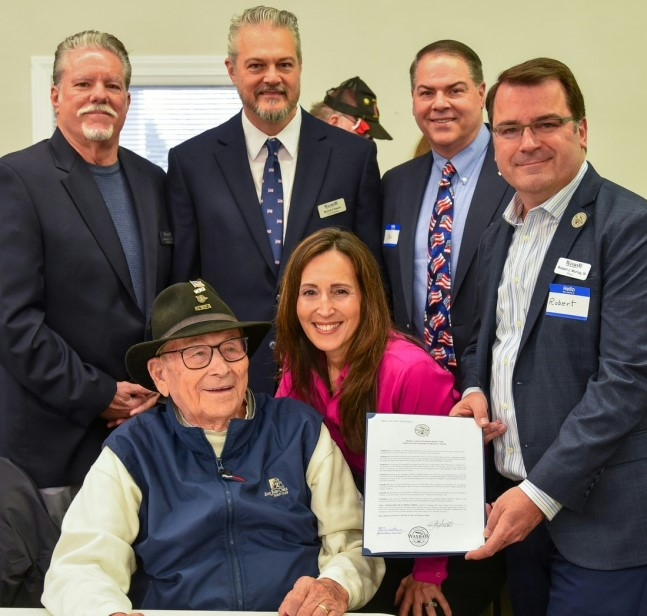
The meeting began on a high note with the adoption of a proclamation honoring Major Charles E. Rose, a 100-year-old World War II veteran and Waxhaw resident. The Board recognized his distinguished military service, dedication to education, and contributions to the community.
It was a fitting reminder that while we debate budgets and infrastructure, we are stewards of a community built by many generations before us.
Cost to Serve Analysis
The bulk of the early meeting revisited the Cost to Serve analysis, originally presented in November.
This study, initiated in 2024, was intended to evaluate which types of development generate positive or negative net revenue for the Town. The goal: identify strategies to strengthen Waxhaw’s tax base.
However, there were important limitations.
When originally requested nearly two years ago (and two town managers ago), we specifically asked that it incorporate major taxpayer costs occurring at the county level — particularly public schools and wastewater capacity. Those large obligations were not included.
To use a simple analogy: my personal budget would look fantastic if I didn’t have to pay my mortgage. But ignoring a major cost doesn’t make it disappear.
Similarly, excluding significant downstream taxpayer burdens presents an incomplete fiscal picture of growth.
The consultant also noted that some categories — such as townhomes and apartments — had small sample sizes, making firm conclusions difficult. The overarching theme of the discussion centered on increasing real ad valorem (property tax) production.
But growth must be evaluated holistically, not just within municipal line items. The board agreed to have the holistic cost to serve pursued.
Red Oak Trails Parking Configuration Settled
The Board revisited parking regulations along Red Oak Trails, reviewing multiple configurations.
Ultimately, consensus formed around restricting parking to the south side of the street, with one ADA-compliant handicap space on the north side (closer to the shops). This approach balances accessibility with roadway width and safety.
Safe Streets for All (SS4A) Grant: Ambitious Scope, Significant Match
The Board discussed pursuing a federal Safe Streets for All (SS4A) implementation grant. The program requires a 20% local match over five years.
The projects under consideration would require approximately $700,000 per year from the Town over that five-year period to fully match the grants.
No decision was made — this was exploratory.
James, the Town’s traffic engineer, indicated that bundling multiple improvements into one application could strengthen the Town’s chances of award. Grants often favor larger, comprehensive proposals aligned with safety, infrastructure, and return-on-investment priorities.
The strategic question now becomes whether Waxhaw is prepared to commit roughly $3.5 million in local funds over five years if the grant is awarded.
Grants reduce cost — they do not eliminate it.
Helms Road Extension Agreement with NCDOT
The Board reviewed a municipal agreement with the North Carolina Department of Transportation for the Helms Road extension.
Staff emphasized that entering into such agreements creates contractual obligations. If the Town fails to meet its commitments, there can be financial or legal consequences.
Infrastructure partnerships require careful review — particularly as long-term maintenance and performance obligations often outlive the current Board.
David G. Barnes Skate Park: Numbers Still Unclear
The longest discussion of the night centered on the David G. Barnes Skate Park.
The park, located on a landfill, has ongoing drainage and design conflict issues. Originally designed for far fewer users, the facility now faces safety and functionality challenges.
Four conceptual options were discussed, ranging from basic repairs (approximately $18,000) to a full holistic redevelopment of the park and surrounding property (unknown cost).
However, there was a recurring concern: the Board did not receive complete financial details ahead of the meeting. Even during the discussion, cost figures were not provided for all variations and refinements being contemplated.
Ultimately, direction was given to refine the lower-cost repair options (Options 3 and 4) for short-term fixes while continuing to evaluate a more comprehensive redesign focused solely on the skate park footprint.
Before committing to any large capital expenditure, the Board will need full clarity on scope, engineering constraints, and long-term durability.
Resolution on Legislative Impacts to Local Zoning
The Board also reviewed Resolution 2026-0001, a general resolution addressing legislative actions that affect municipal zoning and land use authority.
The resolution is structured broadly, allowing the Town flexibility to advocate for its interests as state legislation evolves.
Given ongoing changes at the state level affecting development authority, this remains an important area to monitor.
The Bigger Picture
This work session revealed a recurring theme:
Waxhaw is facing multiple potential financial commitments simultaneously —
- Expanded infrastructure matches
- Road extension agreements
- Park redesigns
- Long-term fiscal modeling questions
Each may be defensible on its own.
But taken together, they require careful sequencing, transparency, and full cost accounting — including impacts beyond Town Hall.
Work sessions are where the groundwork is laid. The real decisions are still ahead.