
The August 11 meeting of the Waxhaw Board of Commissioners was one of the more consequential meetings this year. It began with the return of prayer in Waxhaw town government for the first time since 2019 and ended more than two and a half hours later with discussion about traffic safety at Waxhaw Elementary School.
In between, the Board honored a beloved Waxhaw resident, recognized town employees and local Eagle Scouts, heard from a packed room of residents about data centers, approved a 12-month data-center moratorium, discussed major transportation projects and awarded a $1.6 million road construction contract.
There was a lot to unpack.
Prayer Returns to Waxhaw Town Hall
The meeting opened with an invocation from Joe Lapos — the first invocation at a Waxhaw Board of Commissioners meeting since 2019.
Lapos’ prayer asked God to give the Board wisdom in its decisions and emphasized the responsibility elected officials have to carefully steward the community and the land.
The return of an invocation was significant because it represented the restoration of a tradition that had been absent from Waxhaw’s public meetings for seven years.
The discussion continued during public comments, when Lapos explained that he viewed an invocation not as an effort to promote a particular religion, but as a reminder of the ethical obligations undertaken by elected officials.
Mayor Murray also addressed the subject after public comments, pointing out that the words “under God” in the Pledge of Allegiance and the reference to our Creator in the Declaration of Independence reflect a longstanding American tradition of recognizing that our rights come from something greater than government itself.
Waxhaw Places a 12-Month Moratorium on Data Centers
The biggest issue of the evening was undoubtedly data centers.
The Board held a lengthy public hearing after making clear that there is currently no data-center application pending in Waxhaw. The moratorium is a proactive step intended to give the town time to study the issue and update its Land Development Code before any large-scale facility is proposed.
Town staff explained that the current code’s definition of “server farms” was written for a very different type of facility and does not adequately address today’s enormous, campus-style data centers.
The proposed moratorium does not permanently ban data centers. Instead, it pauses approvals for new data centers, data-processing facilities, cryptocurrency mining and similar primary uses for 12 months. The pause gives the town time to study infrastructure, utilities, noise, land use and other potential impacts and to gather additional public input.
The public response was substantial.
Residents raised concerns about electricity demand, water consumption, noise, environmental impacts and the long-term effect that large data centers could have on the character of Waxhaw. One speaker with decades of experience working for Duke Energy explained why he did not believe Waxhaw was a good location for a large data center, particularly because of the area’s electricity and water infrastructure.
A high-school student, Sophia Wang, also spoke passionately about the issue, arguing that the question before Waxhaw was not whether artificial intelligence is useful but whether large data centers are compatible with the town’s infrastructure and quality of life.
Recent changes in state law have restricted the ability of municipalities to downzone property without the property owner’s consent. That matters because if a use such as a data center were allowed on a property today, the town could have fewer tools available to change that zoning later.
Mayor Pro Tem Wedra encouraged residents to understand how their state legislators voted and to support efforts such as House Bill 170 and House Bill 24 that would restore some of that local authority.
The Board ultimately voted unanimously to adopt the 12-month data-center moratorium.
A Final Word About Waxhaw Elementary
The meeting ended with a discussion that did not appear on the main agenda but deserves attention.
I wanted to update residents who follow the Union County Board of Education on an issue involving traffic directors at Waxhaw Elementary School.
Commissioner Gemignani and I attended a Board of Education meeting because of concerns about the decision to remove traffic directors from the school. At that meeting, we watched the school board decline $3.8 million from the county while saying that eliminating the traffic-director positions would save approximately $200,000.
I remain hopeful the school board will reconsider the decision, at least for Waxhaw Elementary.
Mayor Pro Tem Wedra added that town leadership, including herself and Mayor Murray, town representatives, the Waxhaw police chief, traffic engineers and NCDOT had met with UCPS representatives. All recommended to UCPS that the traffic directors be reinstated, for the following reasons:
- The right-in-right-out dictate from UCPS will funnel a large amount of traffic to a very dangerous intersection (75 and Old Providence).
- UCPS do not have the authority to mandate right-in-right-out on NCDOT roads.
- NCDOT would typically study a change like this for 6 months – UCPS have not performed a proper study.
- UCPS are taking on liability for accidents by removing the traffic director.
- If UCPS are planning to put someone at the school to monitor against people who try to make left turns, why not just put a traffic director out there?
At this point, the decision remains with UCPS and the Board of Education.
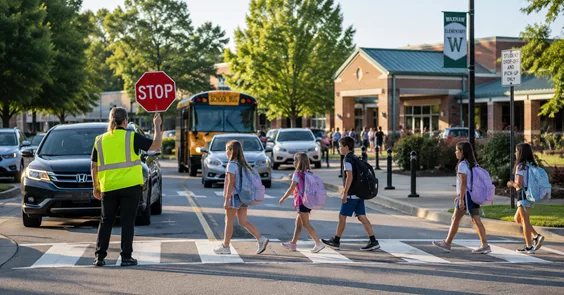
For parents and anyone who drives through the school area, this is about more than a budget line. Traffic directors exist to help children safely cross roads and manage the chaotic traffic environment around an elementary school.
A Meeting That Was About Waxhaw’s Future
The August 11 meeting covered an extraordinary amount of ground: prayer, community, development, data centers, local control, transportation, infrastructure, finances and school safety.
But there was a common thread running through many of those discussions.
Waxhaw is growing, and decisions made today will shape what the town looks like years from now.
The data-center moratorium gives the town time to prepare rather than react. The transportation discussion recognizes that not every worthwhile project can be built immediately. The financial discussion reinforces the need to understand what today’s commitments mean for tomorrow’s taxpayers. And the discussion about Waxhaw Elementary reminds us that sometimes the most important decisions aren’t the biggest ones on a budget spreadsheet.
Good local government requires balancing all of those competing priorities.
And, as the invocation reminded us at the beginning of the meeting, that responsibility is ultimately about stewardship — of our community, our land, our resources and the people who call Waxhaw home.