
Looking Beyond the Tax Rate
When were Waxhaw property taxes raised? The answer isn’t as simple as looking at the tax rate. In fact, residents can experience substantial increases in their property-tax bills even when town officials claim they haven’t raised taxes because they didn’t adjust the rate. When assessed property values go up, failure to adjust the rate downward is effectively a tax increase. To really understand the burden of funding Waxhaw’s government, we need to look at three things: the property-tax rate, assessed property values, and inflation.
The tax rate tells only part of the story. What residents actually pay depends on both the rate and the assessed value of their property. And inflation determines whether the additional money collected by the Town represents genuine growth in its purchasing power.
Let’s look at what has happened over the past decade.
The tax rate doesn’t tell the whole story
Here is the recent history of Waxhaw’s property-tax rate:
| Year | Town property-tax rate |
|---|---|
| 2015–2016 | $0.360 |
| 2018–2025 | $0.385 |
| 2025–2026 | $0.290 |
Waxhaw increased its tax rate by 2.5 cents in 2018, from 36 cents to 38.5 cents (opposed by Commissioners Kat Lee and Brenda Burns). It then maintained that higher rate for seven budget years before reducing it in 2025.
But the rate history alone doesn’t tell us how much the tax burden changed. We also need to account for property revaluations.
2015: A revaluation and a higher tax rate
Union County’s 2015 revaluation took effect on January 1. Interestingly, real property values within Waxhaw actually declined approximately 3%.
The Town’s FY 2015–2016 budget adopted a tax rate of 36 cents per $100 of valuation, up from 34 cents.
The Town described the 36-cent rate as revenue-neutral.
What does that mean?
A revenue-neutral rate is the calculated tax rate intended to generate approximately the same property-tax revenue as the previous year would have generated if the revaluation had not occurred. North Carolina’s calculation also includes a statutory growth adjustment to account for growth in the tax base.
In other words, when property values increase following a revaluation, a lower tax rate can produce approximately the same revenue. Maintaining the previous rate instead can generate substantially more revenue.
Conversely, if property values decrease following a revaluation, a higher tax rate is required in order to produce the same revenue. This is why the town was able to describe the rate increase of 2015 as “revenue neutral”.
2018: The tax rate increased
In 2018, Waxhaw increased its property-tax rate from 36 cents to 38.5 cents per $100 of valuation.
That 2.5-cent increase was maintained through the 2024–2025 budget.
The 2018 increase is notable because it happened between county revaluations. It wasn’t simply an adjustment made in response to a new assessment of property values.
By 2021, when Union County conducted its next revaluation, Waxhaw was already charging 38.5 cents.
2021: Property values increased, but the Town kept its rate
Union County conducted another revaluation in 2021.
Waxhaw failed to reduce its 38.5-cent tax rate to compensate for the higher assessed property values.
The Town’s budget discussion identified a revenue-neutral rate of approximately 32 cents. The Board ultimately retained the 38.5-cent rate.
This inaction was actually a very consequential decision. The combination of higher property values and the unchanged tax rate meant a substantial increase in property-tax revenue – effectively a huge tax hike.
It is worth remembering that revenue neutrality isn’t a tax cut. It is intended to prevent a revaluation from automatically producing a windfall in property-tax revenue simply because assessed values have increased. After all, the cost of running local government doesn’t necessarily increase just because of a change in property values.
For an example of how the politicians of the time avoided responsibility for raising taxes, see my discussion with Commissioner Morey as he avoids the rate issue and blames the county’s revaluation schedule for the sticker shock we experienced as Waxhaw residents. (unfortunately the volume in this video is very low)
2025: Another revaluation and another tax-rate decision
The next Union County revaluation took effect in 2025.
Waxhaw’s FY 2025–2026 budget reported that real property values increased an average of 56.72%.
Consider the Town’s own example:
A house previously assessed at $400,000 was reassessed at $626,880.
That’s a substantial increase in taxable value.
The Town’s budget calculated a basic revenue-neutral rate of approximately 24.73 cents. After applying the statutory growth adjustment, the rate advocated by Commissioners Richard Daunt and Susanna Wedra was 26.2 cents.
But getting to a new tax rate proved anything but straightforward.
A budget battle over the tax rate
At the June 24, 2025 Board of Commissioners meeting, Daunt and Wedra moved to adopt the 26.2-cent adjusted revenue-neutral rate. As expected, their motion was defeated.
However, the three holdover commissioners refused to use their majority to pass any rate without a unanimous vote. This essentially held the town’s finances hostage, as failure to make a decision would mean a takeover from the NC Local Government Commission, and a likely much higher rate.
After approximately four hours of stalemate, the Board ultimately adopted a compromise rate of 29 cents.
What happens when we account for inflation?
There is another important consideration: inflation.
A dollar collected by the Town today doesn’t have the same purchasing power as a dollar collected ten years ago. We therefore need to adjust the tax burden for inflation before deciding whether government has become more expensive in real terms.
Using the Bureau of Labor Statistics’ Consumer Price Index (CPI-U), consumer prices increased approximately 35.8% between 2015 and 2025.
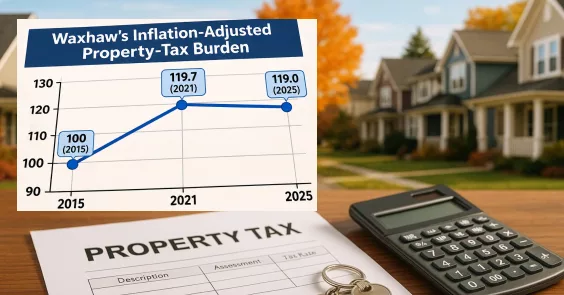
When we combine property-value changes, tax rates and inflation, we get the following preliminary results:
| Period | Change in real property-tax burden |
|---|---|
| 2015–2021 | +19.7% |
| 2021–2026 | -0.6% |
These figures provide an indication of how the Town’s property-tax burden has changed after accounting for inflation.
The bottom line
When evaluating property taxes, residents should look beyond the advertised tax rate.
A government can increase its effective demands on taxpayers without increasing its published rate. Rising assessed property values can generate substantially more revenue, and inflation can make it difficult to distinguish between revenue growth that simply maintains purchasing power and revenue growth that represents an actual increase in the resources available to government.
Waxhaw’s history illustrates this.
The Town increased its tax rate in 2018 and maintained that rate through 2024. Following the 2021 revaluation, it chose not to reduce the rate to the revenue-neutral level. In 2025, after another substantial revaluation, the Board ultimately adopted a lower rate, but not the adjusted revenue-neutral rate advocated by Commissioners Daunt and Wedra.
The question isn’t simply whether Waxhaw raised or lowered its tax rate.
The more important question is how much more it costs residents, in real terms, to fund their local government than it did ten years ago.
That’s the number taxpayers should be watching.