
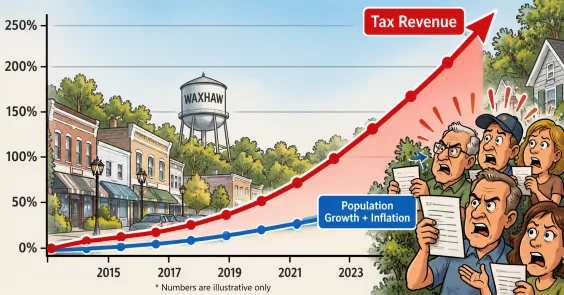
Waxhaw property taxes were a central part of a recent Board of Commissioners discussion about the Town’s financial outlook over the next five years. The presentation examined how slower revenue growth, rising operating costs, debt and capital spending could affect the Town’s finances.
The presentation was not a recommendation to raise property taxes – it was a planning exercise designed to help the Board understand the financial challenges Waxhaw could face and the choices available to address them.
My preference is straightforward: before asking residents to pay more, we should look carefully at what the Town spends, identify recurring savings and make sure we are operating as efficiently as possible. We should also make sure that the services we provide are within the scope of what residents expect.
Why the Town is looking further ahead
Waxhaw’s financial outlook depends on several sources of revenue, including property taxes, sales taxes, franchise taxes and fees. Commercial development brings additional business activity and revenue to the Town. Residential growth, however, is a different calculation.
New neighborhoods do generate additional property-tax revenue in their early years. But that initial revenue can create a misleading impression of the financial benefit. Over time, the Town must provide services to those additional residents and maintain the roads, facilities and infrastructure associated with that growth.
In the end, residential growth is a net financial cost to existing taxpayers. It can provide a short-term sugar high of additional revenue while creating longer-term obligations that are disproportionate to the revenue it produces. We should not assume that approving more homes automatically improves the Town’s financial position.
At the same time, the cost of providing services continues to rise. Employee compensation and benefits, fuel, utilities, contracts, equipment and infrastructure all cost more than they did a few years ago. We live in an inflationary fiscal ecosystem.
The financial analysis looked at several possible futures, including a scenario with only 1% annual revenue growth and operating costs increasing by 4%. It also examined a more severe scenario based on the Town’s recent historical cost increases.
These are planning scenarios, not predictions. The point is to understand what could happen if revenue growth slows while expenses continue to rise.
The analysis also identified an estimated current operating gap of approximately $808,000. In plain English, that means the Town’s recurring operating revenue is not quite keeping pace with the cost of the services it provides, based on the assumptions used in the analysis.
That does not mean the Town is out of money or unable to pay its bills. Waxhaw currently has a healthy fund balance. But using savings to cover a recurring shortfall is not a sustainable long-term solution.
What is the “weighted tax rate”?
One of the more nuanced parts of the presentation was the distinction between the weighted and unweighted tax rates. It’s worth explaining because the numbers can look quite different even though residents are still paying the same adopted tax rate.
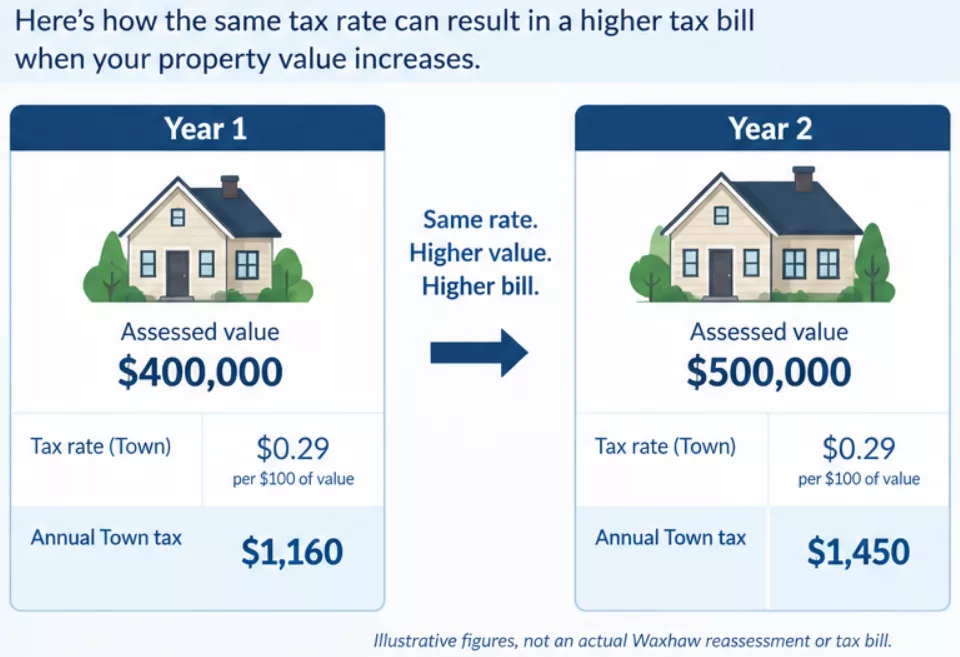
Waxhaw’s current property-tax rate is 29 cents per $100 of assessed property value.
The unweighted rate looks only at the property-tax revenue itself. The weighted rate takes other revenue sources into account – such as sales taxes, franchise taxes and other recurring revenues – and expresses them in property-tax equivalents. This allows the Board to see how the Town’s overall revenue supports operating expenses, debt payments and capital spending, rather than looking at property taxes in isolation.
Think of it this way: the Town has several different sources of income that help pay for its operations. The weighted rate gives the Board a way to look at those sources together, as though they were all expressed in property-tax terms.
Under the analysis presented, the 29-cent rate was divided this way:
- Weighted operating share: 24.4 cents. This represents the property-tax equivalent supporting day-to-day Town operations after accounting for other revenue sources.
- Weighted debt share: approximately 2.87 cents. This represents the portion associated with debt service.
- Weighted capital and transfers: approximately 1.69 cents. This represents the portion supporting capital spending and transfers.
Those figures add up to the same 29-cent tax rate.
The unweighted view looks different. It puts the other revenue sources to one side and shows approximately 21.7 cents for operations and 7.3 cents for debt and capital.
Neither calculation changes what a homeowner pays. They are simply two ways of looking at how the Town’s finances are supported. The weighted view recognizes that property taxes are not the Town’s only source of revenue. The unweighted view is useful when looking specifically at the property-tax revenue available to support obligations.
This distinction also explains why a penny of tax rate can have a different dollar value depending on which calculation is being used. The presentation estimated that a penny represents approximately $843,000 on a weighted basis, compared with about $525,000 on an unweighted basis.
Keeping the tax rate unchanged is not necessarily keeping taxes unchanged
During the discussion, I made a point about something that is often overlooked when comparing property taxes with other taxes.
Income taxes and property taxes work differently. Many income-tax systems adjust tax brackets and allowances over time to account for inflation. Property taxes do not work that way. A property-tax rate stays where the Board sets it until the Board changes it. It does not automatically adjust each year because the cost of living has gone up.
But there is another side to this equation: property values can increase. When assessed values rise, a homeowner’s tax bill can go up even if the tax rate stays exactly the same.
This is why I have a problem with politicians who say, “We didn’t raise the tax rate,” as though that automatically means they haven’t raised property taxes. That statement may be technically true, but it can be misleading. If property values have increased and the tax rate has not been lowered to account for those higher values, homeowners still end up paying more.
The relevant question isn’t simply whether the tax rate changed. It’s whether the Town is collecting more property-tax revenue from residents and why.
A fixed tax rate does not automatically keep the tax burden constant. And just as importantly, the fact that Town expenses rise with inflation does not mean the answer should automatically be to collect more from taxpayers.
We need to be transparent about both sides of the equation: what it costs to provide services and how much we are collecting from residents.
Can we find savings instead?
Toward the end of the presentation, I raised the importance of looking for recurring cost savings rather than treating a tax-rate adjustment as the inevitable answer to a financial gap.
There is a difference between one-time savings and recurring savings. Delaying a purchase or leaving a position vacant temporarily may save money in one budget year. It does not necessarily solve an ongoing structural problem. What we need to identify are savings that continue year after year.
The Town Manager mentioned two areas where savings may be possible: the fixed-asset program and the purchasing program. He also pointed out that municipal government is different from a private business. A company may pursue savings to improve its profit margin, while a town’s responsibility is to provide public services. Some costs, particularly employee benefits, fuel and other essential operating expenses, are difficult to control.
That is fair. We cannot eliminate necessary expenses simply to hit an arbitrary target. But we should continually look for better ways to purchase, maintain equipment, manage contracts and deliver services.
We should also remember that the Board has control over both operating and capital spending. The financial outlook is not something that simply happens to us. We make decisions about staffing, services, projects, debt and the timing of capital investments. Those choices have a direct impact on the Town’s future financial position.
Financial Planning
This was an initial financial planning discussion. The Town still expects additional analysis from its financial adviser, Davenport, and further verification of the assumptions and figures.
The Board will have more information to consider as it prepares for future budget decisions, including the FY2027–28 budget.
For my part, I want to keep the current property-tax rate in place if we can do so responsibly. That means taking a hard look at recurring expenses, looking for efficiencies, being careful about new commitments and making thoughtful decisions about capital spending.
Residents are dealing with higher costs in their own households. Many people, particularly retirees living on fixed incomes, do not have the benefit of regular cost-of-living increases. We should be mindful of that when making decisions about Town finances.
The objective should be to live within our means, protect essential services and make the best use of the revenue we already collect—not to look for reasons to raise taxes.