
The Waxhaw Board of Commissioners’ September 22 work session covered a lot of ground, from the Town’s developing strategic plan to data centers, growth policy, speed-limit requests and the property-tax-supported budget.
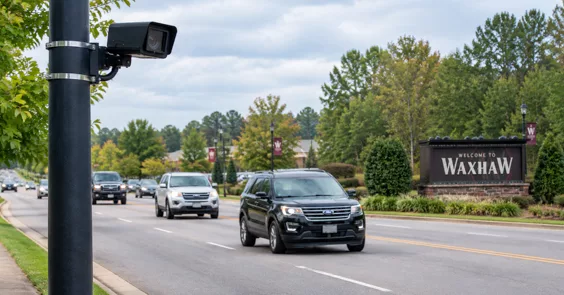
But the discussion that generated the most questions — and probably the most interest for residents — was a lengthy examination of Waxhaw’s use of automated license plate reader cameras, commonly known by the brand name Flock.
There was considerable agreement that the technology can be an important law-enforcement tool. But there was also a serious discussion about something that is harder to quantify: how do we make sure a technology adopted to improve public safety does not eventually become a tool for excessive government surveillance?
That question became especially important because of the sheer amount of information the system collects. Police said Waxhaw’s network generates approximately 8 million license-plate reads in a typical month. Officers are not watching those vehicles in real time, and police said they do not look at an individual plate unless it is connected to an investigation or other authorized purpose.
The system is capable of creating a record showing that a particular vehicle was at a particular location and time. At present, the Town’s cameras are primarily positioned at major entry points, while additional cameras operated by HOAs, businesses and other private entities can also be part of the broader network.
The benefits are real
The police presentation made clear why officers value the technology.
One of the most striking examples involved a registered sex offender whose license plate was already flagged through the national criminal information system. When his vehicle entered a Waxhaw neighborhood, officers received an alert within seconds. Officers went to the area and found the man attempting to talk with young children. No charges were filed in that particular incident, but police were able to intervene immediately and the individual did not return.
Police described another case in which a person sexually assaulted someone in a Waxhaw neighborhood. Once officers obtained the vehicle’s plate and entered it into their hot list, the system alerted them within seconds when the vehicle entered another neighborhood. Officers located the person, identified him and he was subsequently charged.
There were also examples involving missing and vulnerable people. Police described using the system to locate a woman whose family had lost contact with her after her phone died during a trip, as well as an elderly man with dementia who had driven away from home. In the latter case, information was shared with other law-enforcement agencies and the man was located and reunited with his family within 24 hours.
Those are compelling uses of the technology. As one commissioner put it during the discussion, if a child, an elderly person or another resident is in danger, people understandably want police to have every legitimate tool available to find them quickly.
The concern isn’t today’s police department
Several commissioners stressed an important point: the concern is not necessarily what Waxhaw Police are doing with the cameras today. It is what the technology could become tomorrow.
The current system does not use facial recognition, does not collect biometric information or audio, and does not identify the people inside vehicles. Police described the cameras as a vehicle-information tool rather than a person-identification system.
But commissioners questioned whether those limitations are permanent hardware limitations or simply the capabilities of the system as currently configured.
That led to one of the most important parts of the discussion. Commissioners pointed out that technology can change through software upgrades and that future versions of a system could potentially have capabilities that today’s system does not. One commissioner essentially asked: What happens if the technology changes, but the Board’s policy does not?
Another commissioner noted that the concern is not a lack of trust in today’s Waxhaw Police Department. It is the fact that today’s elected officials and police leadership will not necessarily be the people making these decisions years from now.
That is a legitimate governance question. Good policy cannot depend entirely on having the right people in office at a particular moment.
The COVID discussion brought the concern into sharper focus
The discussion took an especially personal turn when commissioners talked about the restrictions on movement that occurred during the COVID-19 pandemic.
One commissioner pointed out that in 2020, Americans experienced restrictions on freedom of movement that many people had never imagined possible. He recalled not wanting police officers to be put in the position of enforcing lockdown rules and argued that Waxhaw should make sure its camera system could not be repurposed for something similar in the future.
Another commissioner described his own experience during the pandemic, when his work required him to travel and he carried documentation explaining why he was permitted to be on the road. The point was not that Waxhaw currently has any plan to use Flock cameras for that purpose. Rather, the discussion illustrated why guardrails need to be established before extraordinary circumstances arise, rather than relying on whoever happens to be in charge at the time.
That concern was summed up particularly well when one commissioner acknowledged both sides of the issue: he did not want government overreach or to be surveilled, but he also recognized the value of having cameras available when something serious happens. He described the difference between voluntarily carrying a smartphone and government being able to assemble a “mosaic” of someone’s movements throughout town.
One camera is useful. How many is too many?
The Board also discussed what happens when the network grows.
One camera at a strategic entrance can provide useful information after a crime. But if one camera is good, is two better? Is three better than two? And where does it stop?
Commissioners raised the possibility that a growing network could eventually provide enough information to reconstruct people’s movements throughout town. One commissioner specifically questioned who decides where additional municipal cameras are placed and who ultimately has responsibility for that decision. The discussion also raised constitutional and Fourth Amendment questions surrounding a surveillance system that expands without specific elected-board approval.
There is another wrinkle: not all of the cameras visible around Waxhaw belong to the Town. Police explained that cameras at places such as Walmart, Lowe’s and Millbridge are privately operated, while the Town currently has five cameras positioned at major entry points. Those private cameras can contribute to the larger network of information available to law enforcement.
That makes the question of limits even more important. The Town may control its own cameras and policies, but it operates within an environment where many other cameras already exist.
What safeguards are in place?
Police explained that Flock’s system has auditing tools that flag certain unusual searches by PD, including repeated searches of the same plate under different case numbers or reasons. Searches continuing beyond certain periods can also trigger a review. The department is conducting periodic audits, and officers who need a vehicle placed on a hot list must provide the reason, related case and vehicle information. Hot-list entries are automatically set for deletion after 90 days unless there is a justification for retaining them longer.
The larger question raised by the Board, however, was whether those safeguards are enough for the future.
The default Flock retention period is seven days, while Waxhaw’s policy currently retains the data for 30 days. Commissioners questioned whether 30 days is really the appropriate “sweet spot” or whether less information should be retained when it is not needed for an investigation.
Looking beyond the current technology
By the end of the discussion, the board expressed interest in establishing stronger guardrails before the technology evolves further.
Commissioners discussed prohibiting facial recognition and RFID data collection and creating a mechanism requiring the Police Department to bring significant expansions of Flock’s capabilities back to the Board for review.
They also discussed whether any additional Town-owned cameras should require specific Board approval, rather than simply being added through a future budget. The Board ultimately agreed that these issues warranted further work and that a formal request should be made to explore appropriate legislation or policy.
That approach recognizes both realities of the issue.
Flock cameras can help police respond quickly to serious crimes, find missing people and protect vulnerable residents. The examples presented at the meeting demonstrate that benefit.
At the same time, the fact that a technology is useful does not mean there should be no limits on how far it can go. With millions of vehicle reads being generated every month and technology continuing to evolve, reasonable questions about retention, access, future capabilities and the expansion of the camera network deserve answers.
The Board’s discussion ultimately was not about choosing between public safety and privacy. It was about trying to preserve the public-safety benefits while putting guardrails in place so that today’s technology does not quietly become tomorrow’s surveillance system.
That is a conversation worth having before the technology changes—not after.
The following video is queued up to the Flock discussion:
A strategic plan for the next several years
Earlier in the meeting, the Board also continued its work on Waxhaw’s strategic plan.
Staff explained that the process began with the Board’s February retreat, where commissioners identified challenge themes and foundational priorities. Those priorities have since been developed into longer-term goals, strategies and shorter-term tactics.
The four broad areas discussed were infrastructure and connectivity, growth management, economic sustainability and organizational development.
One theme running through the discussion was the desire to connect the Town’s goals to actual budgeting and day-to-day operations rather than creating a plan that simply sits on a shelf.
Staff expects to continue refining the plan, establish time horizons and develop ways to measure progress. The Board will revisit the plan periodically rather than treating it as a document that is permanently fixed.
That’s an important part of making a strategic plan useful: residents should eventually be able to look at the Town’s stated priorities and see how those priorities translate into actual spending and decisions.
Data centers: Planning for a rapidly changing industry
The Board also spent considerable time discussing how Waxhaw should regulate data centers. The discussion comes as the Town works through a 12-month moratorium on new data centers that was approved in July. Staff reported that they have been researching how other communities are addressing the issue, including reviewing ordinances and contacting more than 40 municipalities.
The research shows that communities are taking several different approaches. Staff found 57 jurisdictions that have taken some type of action related to data centers. Of those, 35 had adopted or extended a moratorium, while others were developing or had adopted permanent regulations. Among the communities with standards available for comparison, the most common approaches place data centers in heavier industrial districts and require either a special-use permit, conditional zoning, or specific requirements that must be met before construction.
The Board’s discussion focused less on whether data centers are inherently good or bad and more on what safeguards would be appropriate if one were proposed in Waxhaw.
Members discussed issues including noise, water consumption, electrical demand, utility capacity, setbacks, buffers, building height, emergency generators, decommissioning and architectural standards. Staff noted that other communities are using a variety of requirements, including noise studies and limits on generator operation.
Water and electricity were particular concerns. The Board discussed how a data center’s actual resource demands could change as a project expands, and whether protections could be built into the approval process. Staff noted that Waxhaw does not control the electric or water utilities, although utility capacity and other requirements can still be considered in local regulations.
Another important question was how much public involvement should occur before a data center could be built. A permitted-by-right use generally does not require a public hearing if the project meets the established standards. A conditional zoning or special-use process, by contrast, provides an opportunity for the specific proposal to be reviewed and for conditions to be considered.
The Board discussed the challenge of writing regulations for an industry that is changing quickly. What might have been considered a typical “server farm” a decade ago can now involve very large campuses and substantially different demands. Members questioned whether putting data centers on a fixed list of permitted uses could leave the Town continually trying to update its regulations as the technology evolves.
The Board also discussed getting public input. Rather than simply asking residents for open-ended comments, staff suggested a more structured survey that could ask residents about specific concerns and priorities while explaining the limits of what the Town can regulate under current state law.
No final data-center ordinance was adopted at the meeting. Instead, the discussion gave staff additional direction as they continue researching the issue and developing potential regulations.
Data center discussion queued here:
Updating Waxhaw’s Growth Strategy webpage
The Board also discussed updating the Town’s Growth Strategy webpage to give residents a clearer picture of how Waxhaw’s current land-use environment developed.
The discussion centered on making the page more useful and more complete by explaining the major changes that occurred over roughly the past seven to eight years, including the Town’s transition from the former UDO to the Land Development Code and the significant townwide rezoning that occurred during that period.
Board members specifically discussed making the changes easier for residents to understand visually. One suggestion was to show side-by-side, color-coded maps illustrating what zoning looked like before the mass rezoning and what it became afterward. The goal would be to make the magnitude of the changes easier to understand without requiring residents to work through the Town’s detailed land-use maps and development code themselves.
The Board also discussed updating the webpage so that it explains not only what happened in the past, but how those changes relate to current state legislation and the Town’s present-day land-use authority. Staff indicated that the information could eventually become part of a broader Development Services section on the Town’s new website.
The emphasis was on giving residents a clearer timeline and better explanation of how Waxhaw arrived at its current growth and development framework.
The Board’s next regular meeting is scheduled for Tuesday, October 13th at 6:30pm.