
The latest industry-funded housing studies from North Carolina’s homebuilding lobby are being used to make their familiar arguments: residential development is an economic engine, it pays for itself, and local governments should get out of the way. But before elected officials and residents accept those conclusions, they should ask a basic question: Who paid for this research, and what interests does it serve?
These are not independent government studies commissioned to examine the full costs and benefits of residential growth. They are reports commissioned by organizations with a direct financial and legislative interest in encouraging more homebuilding and eviscerating the power of local governments who put their residents first.
The findings of industry-independent experts and academics also contradict this study.
Follow the money
In February 2025, the NC Chamber Foundation, the North Carolina Home Builders Association (NCHBA), and NC REALTORS® commissioned a housing supply study that announced a projected shortage of 764,478 homes in North Carolina by 2029.
The report also promoted the possibility of $489 billion in economic activity and nearly 2.2 million jobs if that projected housing gap were addressed. Those are enormous figures, and they make for compelling headlines. But the study was commissioned by organizations whose members stand to benefit from policies that encourage more residential construction.
The latest report, Economic Impacts of Owner-Occupied Residential Construction in North Carolina: Update 2026, is even more direct about its sponsor. It was prepared for the North Carolina Home Builders Association by economist Dr. Michael L. Walden.
The NCHBA is not a neutral public agency. It is a membership organization representing the homebuilding industry. Its own website describes its active legislative presence and its work to protect the interests of its members.
Economic activity is not the same as fiscal benefit
The 2026 report puts some impressive numbers on the table. It estimates that construction of single-family homes and townhouses in 2025 generated approximately $46 billion in economic activity, hundreds of thousands of jobs, and billions in public revenue.
But those figures need context.
The job estimates include direct construction employment, jobs at suppliers, and jobs supported by additional spending. The economic activity figures include those same indirect and induced effects. They are measures of economic activity across the state—not a count of permanent jobs created in any particular town.
More importantly, the public revenue figures combine local, state, and federal revenues. A dollar collected by the federal government does not pay for a traffic signal in Waxhaw. State revenue does not automatically become money available to a town dealing with the consequences of new subdivisions.
The report then attempts to answer whether new housing pays for itself by comparing selected public revenues with selected public costs. That is an improvement over the 2025 study, which promoted enormous economic benefits without making a comparable calculation of the public costs.
But an improvement is not the same as a complete analysis.
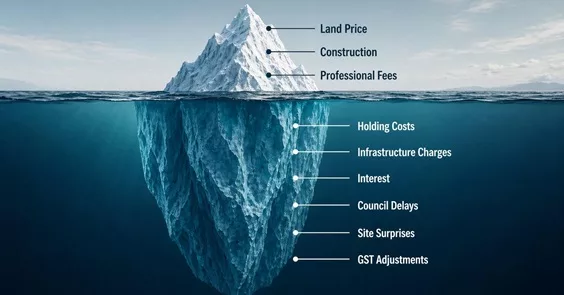
The 2026 report focuses heavily on education, transportation, public safety, and government administration. It relies on statewide averages and assumptions about the households moving into new homes. It does not provide a comprehensive accounting of the marginal costs faced by individual towns and utility systems.
Where are the full costs of stormwater infrastructure, parks, public works, road maintenance, and the long-term replacement of infrastructure? What about the cost of expanding water and sewer capacity? What happens when a development pushes a local system closer to its limits?
These are not minor details. They are the practical financial questions local governments have to answer.
Who pays for water and sewer capacity?
The report states that builders of new construction typically pay directly for needed water and sewer investments. That sounds reassuring, but it does not establish that developers pay the full cost of expanding and maintaining the systems that serve growing communities.
Consider Union County Water.
Its own financial information makes clear that the utility is funded by rates and fees charged to customers and developers. Its 15-year capital improvement plan totals approximately $845 million, including $216 million for wastewater infrastructure. That plan covers not only expansion, but also maintenance, rehabilitation, renewal, and replacement.
The County’s FY2026-27 budget also includes a 6% sewer rate increase to help fund sewer plan projects.
So yes, developers pay fees and may construct infrastructure within their developments. But customers and other ratepayers also help fund the broader utility system. The existence of development fees does not prove that every growth-related cost has been fully recovered from the development that created the demand.
That matters to the local homeowner who receives a higher utility bill.
A statewide economic model cannot tell that homeowner whether a particular subdivision is paying its fair share of the infrastructure needed to serve it.
The local control question
There is another important piece of this story.
While the homebuilding industry has been promoting studies that portray residential construction as an economic winner, the NCHBA has also been actively advocating for legislation that would restrict local governments’ authority over development.
In May 2025, the association publicly mobilized members to Raleigh in support of House Bill 765, the Save the American Dream Act. The bill proposed sweeping changes affecting local development regulations, planning authority, and water and sewer capacity decisions. Fortunately it did not become law; its last recorded action was a referral to the House Finance Committee. The industry’s efforts have not ceased, however, as some of the changes proposed in 765 have appeared in subsequent bills.
The industry wants us to accept its economic studies as evidence that residential development benefits the public, while also seeking to limit the ability of local governments to evaluate and manage the consequences of that development.
If residential growth really does pay for itself, why should the industry be so concerned about allowing local governments to examine the actual costs, infrastructure capacity, and impacts on existing residents?
Why should a statewide average override the judgment of local elected officials who are responsible for the roads, public services, and infrastructure in the communities absorbing that growth?
The people paying the bills deserve an independent assessment
The central weakness of these reports is not that they show residential construction creates economic activity. Of course it does. Builders hire workers, purchase materials, pay taxes, and support local businesses. Nobody seriously disputes that.
The question is whether the benefits outweigh the full public costs—and who receives those benefits and pays those costs.
The benefits of development are distributed across a broad economy. The costs are often concentrated in the communities where the homes are built. A statewide report can count construction spending and tax revenue across North Carolina, but it cannot establish that Waxhaw, or any other individual town, comes out ahead.
That requires local analysis. It requires looking at actual infrastructure needs, actual service costs, actual revenue retained by the local government, and the long-term obligations created by growth.
And it should be done by researchers who are not being paid by the very industry whose claims are being evaluated.
An independently commissioned study should examine the full picture: the benefits, the costs, the assumptions, the limitations, and the differences between communities. It should be willing to reach conclusions that homebuilders may not like.
Until then, these industry-funded housing studies should be treated for what they are: research commissioned by interested parties to support an argument about public policy.
North Carolina needs a sensible housing policy. It needs homes people can afford, responsible infrastructure planning, and economic development that benefits existing residents.
What it does not need is a public policy debate driven by reports that count the economic benefits of growth while leaving local communities to argue over the bills.
Residents deserve more than a sales pitch. They deserve an honest accounting.